
How Small Home Service Businesses Can Build a Scalable Customer Acquisition Process
On October 22, 2026 by Build for GrowthA small home service business can grow quickly when referrals are strong, but relying almost entirely on word of mouth can make customer acquisition unpredictable. One month may bring more work than the team can handle, while the next month may require the owner to spend valuable time looking for new opportunities.
Referrals remain valuable, but growing contractors eventually need a process that does more than depend on personal networks and occasional advertising. A scalable customer acquisition process gives the business several consistent ways to attract potential customers, turn interest into inquiries, and follow up without requiring the owner to personally manage every step.
The goal is not to create a complicated corporate marketing system. It is to build a practical process that can grow alongside the business.
Why Referrals Alone Can Create Unpredictable Growth
Referrals are often one of the most trusted sources of new business for contractors. A homeowner who receives a recommendation from someone they know may already have a degree of confidence before making contact.
The problem is timing.
A contractor cannot control exactly when previous customers will need another service or when someone will recommend the business to a new customer. Referrals can therefore fluctuate even when the quality of the work remains consistent.
The same issue can occur with inconsistent advertising. Running an advertisement only when the schedule becomes quiet creates a reactive cycle: business slows down, advertising begins, inquiries increase, work fills the schedule, and marketing is paused again.
A more structured approach keeps customer acquisition active even when the business is busy.
That does not mean abandoning referrals. Instead, referrals can become one part of a broader system that also includes a website, targeted advertising, useful content, lead capture, and follow-up.
Define the Customers and Services You Want to Attract
Before investing more money in marketing, a contractor should decide exactly what type of customer and work it wants more of.
A general contractor may want larger renovation projects rather than small repair jobs. A landscaping company might want recurring maintenance contracts. An electrician could be looking to grow a particular service line rather than simply increase calls for every service it offers.
This distinction matters because marketing becomes much more effective when the message has a clear purpose.
Businesses considering additional customer acquisition channels can also review Home Pro Leads while defining which types of prospects they want to attract and how those opportunities fit into their existing sales process.
A useful customer profile can include location, property type, service needed, project size, urgency, and likely buying timeline.
The business does not need a complicated market research report. Even a simple description of the customers it wants more of can help guide advertising, website content, and lead qualification.
Create Multiple Paths for New Inquiries
A scalable acquisition process should not depend on one source of customers.
Different prospects discover service businesses in different ways. Some may search online, others may click an advertisement, see a social media post, read an article, receive a referral, or return after previously visiting the company’s website.
Each channel can serve a different role.
A website provides a central place for prospects to learn about services and make contact. Paid advertising can capture people who are actively searching. Educational content can reach customers earlier in their decision-making process. Referrals can introduce the business through existing relationships.
The objective is not to use every available channel.
Instead, businesses should identify the channels that make sense for their customers and build a manageable process around them.
Connect Advertising With Conversion-Focused Landing Pages
Advertising can bring visitors to a website, but the website needs to help those visitors take the next step.
One common mistake is sending every advertising visitor to the homepage.
A homeowner searching for a specific service should ideally reach a page that directly addresses that service. A roofing advertisement should lead to information about roofing, while an electrical repair campaign should lead to a relevant electrical service page.
The landing page should answer the visitor’s basic questions and provide a clear action.
That action could be requesting an estimate, calling the business, booking an appointment, or submitting a project inquiry.
The closer the connection between the advertisement, landing page, and customer’s actual need, the easier it becomes for the visitor to understand what to do next.
Track Leads From First Contact to Follow-Up
A customer acquisition process becomes much more useful when the business can see what happens after someone makes contact.
Simply counting website forms or phone calls does not tell the whole story.
A contractor should ideally be able to identify where an inquiry came from, what service it relates to, whether it is a suitable opportunity, and what happened afterward.
A simple tracking process might record:
- Source of the inquiry
- Customer and contact information
- Service requested
- Location
- Project timeframe
- Lead status
- Next follow-up date
- Outcome
This does not require an expensive system from the beginning. A small business can start with a basic CRM, spreadsheet, or other organized method and improve it as the volume of inquiries increases.
The important thing is consistency.
If every lead is recorded differently, the business will struggle to identify patterns or determine which acquisition activities are actually producing useful opportunities.
Build a Repeatable Follow-Up Process
Generating a lead does not guarantee a sale.
A potential customer may request an estimate and then need several days to compare options. A renovation project may not begin for months. A homeowner may make an inquiry and then become temporarily unavailable.
Without follow-up, suitable opportunities can disappear.
A repeatable process should define what happens after the initial inquiry.
For example, a contractor might confirm the request, gather missing information, schedule a consultation, provide an estimate, and establish a reminder for follow-up if the customer does not immediately move forward.
The process should also distinguish between different types of leads.
An urgent plumbing problem may require immediate attention. A homeowner planning a major renovation next spring may belong in a longer-term follow-up process.
Creating these distinctions allows a small team to prioritize its time without losing track of future opportunities.
When Outsourcing Lead Generation Can Support Growth
As a home service company grows, the owner often becomes responsible for more than the actual work. Estimating, scheduling, hiring, purchasing, customer service, and administration can all compete for attention.
Marketing can easily become something that gets handled only when there is spare time.
At that stage, external support may help the business maintain a more consistent acquisition process.
For contractors evaluating a managed lead generation system, the important consideration is how that system fits into the company’s existing operation. The business should understand what type of customers it wants, which services it is trying to grow, how inquiries will be handled, and who will be responsible for following up.
Outsourcing one part of customer acquisition does not eliminate the need for internal processes.
If a company generates more inquiries but cannot respond promptly, the underlying problem has simply moved further down the customer journey.
Keep the System Flexible as the Business Expands
A customer acquisition process that works for a small contractor may need to change as the company grows.
A business with one owner and a few technicians may only need a simple lead-tracking process. A larger company may need separate sales responsibilities, automated notifications, multiple service areas, and more detailed reporting.
The basic principles can remain the same.
The business should know who it wants to attract, where those customers can be reached, how they can make contact, how inquiries are qualified, and what happens next.
The U.S. Small Business Administration recommends treating marketing as a planned business activity, including defining a target market, setting marketing and sales goals, outlining specific actions, budgeting for those activities, and measuring results. Its small-business marketing planning guidance provides a useful framework that can be adapted to a home service company.
The advantage of having this structure is that decisions become easier to make. When the business knows which services it wants to grow and can see where inquiries are coming from, it can adjust its marketing based on actual business needs rather than guesswork.
Build a Process That Can Grow With the Business
Scalable customer acquisition does not mean a contractor needs a large marketing department or a complicated technology stack.
It means replacing an unpredictable collection of referrals, occasional advertising, and personal networking with a process that can be measured and repeated.
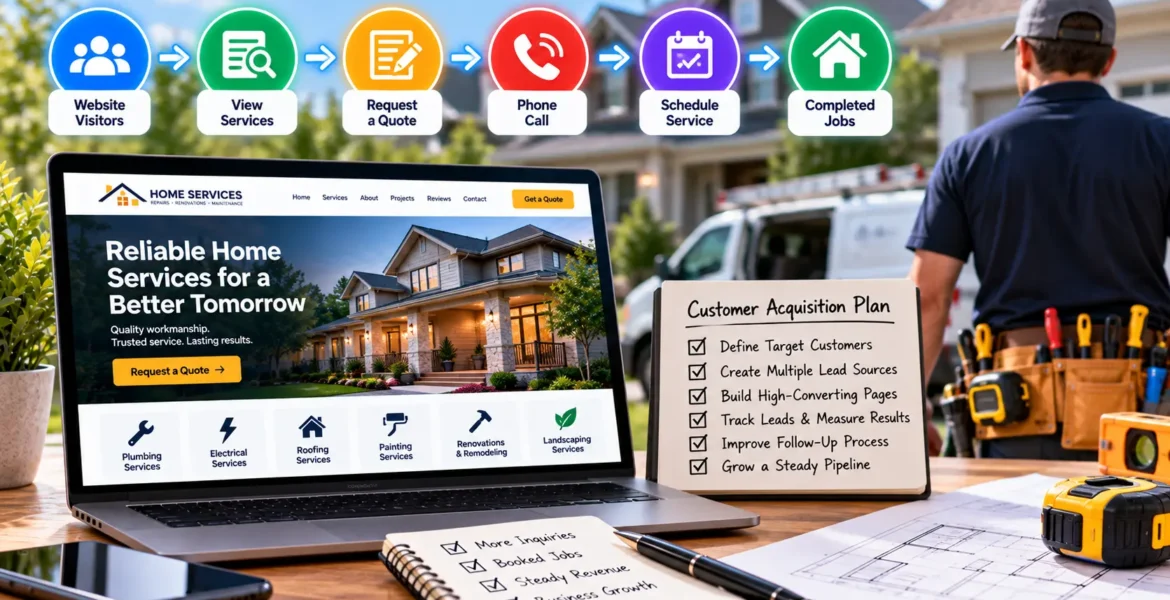
The foundation can be straightforward: define the right customer, create several appropriate paths to attract them, build useful landing pages, make inquiries easy, track what happens afterward, and establish consistent follow-up.
As the company grows, each part of the process can become more sophisticated.
What matters most is starting with a system that the business can actually maintain. A reliable acquisition process should support the owner’s workload rather than create another source of daily chaos.
When customer acquisition becomes a repeatable part of the business, growth becomes easier to plan for—and the owner spends less time wondering where the next opportunity will come from.